Farewells (to be updated) - CHECK RORY
Alex Boyd-Williams
To come
Writer tbc
William Buckley
Since arriving in the Michaelmas Term of 2012, Will has been a constant presence in Chemistry: steady, practical, organised and impossible to ignore. Like a good catalyst, he has made everything around him work better, without seeking any credit for himself.
He has been the sort of colleague and head of department every teacher hopes for. Pupils both respect and like him because he is always straightforward with them. He never tolerated nonsense, and he rarely needed to raise his voice - but on the rare occasions he did, not only his own class but those in neighbouring classrooms instantly paid attention. That quiet authority, combined with his wonderfully dry humour, made him an exceptional teacher and colleague.
He has been fiercely protective of the department, but just as ready to challenge it when something needed to be done differently. He took on the hard jobs without fuss, worked tirelessly for both colleagues and pupils, and was often to be found in the Department in the holidays, quietly getting everything ready. There has also always been a striking generosity about him: with his time, with his energy, and with the support he offered so readily to those around him.
There are so many things that colleagues and pupils will remember. His determination to get in through the snow, even when that meant a 6 km cross country walk. The legendary biscuit challenge with the Sixth Form. His alarming coffee mug, which often looked as though it had undergone some regrettable chemical experiment. His roles beyond the laboratory, including Master in charge of Squash and his devoted work as a Tutor in Abbey House.
The biscuit challenge in particular says a good deal about him, other than the fact that he enjoys a biscuit. In a weekly double lesson with the Sixth Form, a rare moment was allowed for something off-topic. Boys took it in turns to bring in two packets of different biscuits. Alongside a coffee, the class would try one of each biscuit before voting for their favourite. The winner would go through to the next round the following week, to face a new challenger biscuit bought by the pupil ‘on duty’ that week. It was, in its own way, both gloriously ridiculous and experimentally methodical - a competition run with more seriousness than some scientific trials. Yet it also revealed something important about Will: beneath the no nonsense manner and high standards was someone generous with his time, keen to build community, and fully aware that good teaching also depends on interest, humour, and mutual respect.
As the Abbey Housemaster so perfectly put it, his dry humour, wise counsel, and deep understanding of teenage boys made him a natural and invaluable presence in a School.
Quite simply, it is hard to think of a better Teacher or Head of Department. He has been ready to help, to listen, and to support, no matter how busy he was. He will be missed greatly - by colleagues, by pupils, and perhaps most immediately by the biscuit tin, which may at last have a chance to remain full.
Nick Scorer
Robert Costin
Robert Costin arrived here from Thailand, having also previously held positions at Bedford, Worksop, Highgate and Ardingley. At Sherborne has been the Head of Academic Music, School Organist, Brass Co-ordinator and a tutor in Abbey House.
Over his four years at Sherborne he has been a highly-valued teacher, colleague and musician. Robert has overhauled the Third Form curriculum which, as evidenced by numbers of boys going on to GCSE and A-level Music, has been a significant achievement. He has overseen many Oxbridge musicians as they have headed towards the Dreaming Spires or the River Cam (as well as other universities) to study Music. He has had a masterly control of the Brass Band – often getting them playing arrangements he has personally concocted for the group in order to emphasise the ensemble’s strengths. However, Robert’s most prominent contribution has arguably been in his inspiring organ playing in the Abbey and Chapel. His skilful accompaniment was always such a consistent support to the Choir and to the congregational singing; his organ voluntaries never far short of perfection. Robert also recorded two albums of organ music – one, of JS Bach’s monumental Art of Fugue at Trinity College, Cambridge and another on the Abbey’s organ of CPE Bach, Haydn and Mozart. Both albums were highly acclaimed, rightly gaining many five star reviews. Robert is to take on a role as a Head of Creative Arts at a school in North Carolina, USA and leaves with our best wishes and many thanks.
Alexander Eadon
Emma Drake
To step into Emma’s studio was to step into the middle of an idea that hadn’t quite finished happening. Prints and paper, objects and works-in-progress drifted across every surface; her desk was less a desk than a sediment. To the uninitiated, it looked like pure disorder. It wasn’t. It was a mind working out loud, and somewhere in all of it she knew precisely where everything was, and, more to the point, where it was going, or so she told us.
She had much the same effect on the boys. They would arrive in her room neat, careful, anxious to do the tidy thing, and Emma would gently, relentlessly dismantle all of that. Ideas came off her faster than most could catch them: suggestions, provocations, “what if you tried —”, half a dozen directions opening up before a boy had committed to one. It was, frankly, bewildering at first. Portfolios that had set out to be safe found themselves pulled, usually against the boy’s better judgment, into stranger and far more exciting fine art territory. She would drag them there, kicking and screaming, the lazy ones especially, until they had built portfolios that were brilliant, personal, and unmistakably their own. The neatness rarely survived contact with her.
And here is what the chaos concealed: underneath it ran an absolutely rigorous method. Emma was a fiend for the assessment objectives. She drilled them, returned to them, held every wandering portfolio up against them until a boy knew exactly what each piece was doing and even sometimes, why. The studio might have looked like a happy accident, but nothing in it was accidental. Exploration and the assessment objectives were never at war in her room; she simply refused to let a boy choose between making real art and hitting the mark - and so, somehow, they did both.
It all came into land at the end. Every end-of-term exhibition, every moderation show, the same quiet miracle: the scatter resolved, the half-finished things turned out to have been going somewhere all along, and the walls filled with work that was genuinely good and genuinely well graded. Boys who had spent half a term convinced they were lost would stand in front of their own exhibition, faintly astonished at themselves. Order, pulled out of chaos.
What I will miss is the nerve of it. Anyone can keep a tidy room; it takes a particular kind of teacher to let a studio get gloriously out of hand and trust that it will resolve, because she has done the hard, invisible work to make sure it does. Colleagues will miss her energy, her humour, and the sheer creative force she brought into the department. We are only now learning how much of the apparent mess was, in truth, Emma quietly holding everything in place with an eye on the long game.
Having taken one last cohort through assessment with her and hung one last show together, I have begun to grasp what the department is about to lose. A real wealth of knowledge: a printmaking guru, certainly, but more than that, a fantastic educator with a rare feel for how to teach this crazy subject. And, on a more personal note, someone I have learned a great deal from; someone who has stood beside me through the good times and the bad, a sounding board, and a friend to laugh with and share the load. I will miss her more than she knows.
We wish her every happiness in her future adventures, whether that’s digging for archaeological treasures in far-flung lands, sea swimming whilst trying to avoid the Ringstead Beast, or filling her own studio to the gunwales with found objects, inks, papers, and prints — and, equally, that we don’t see her on an episode of Extreme Hoarders any time soon.
She leaves the studio much quieter, tidier, and indeed a good deal poorer for it. Whatever she turns her hand to next, it will be the same method in the same madness: chaos invited in, indulged, and enjoyed.
Matt Bone – Director of Art
Alexander Eadon
Alex Eadon was appointed Director of Music in the autumn of 2024. He was fortunate in that he took over a Music department that was already a well-oiled machine with excellent staff. However, Alex led the musical life of the School for the next two years during which time his passion for and dedication to all things musical was always in evidence, and the quality of music has only improved further.
With a sharp intellect combined with a sense of humour, Alex brought joy to many Shirburnians in their day-to-day musical activities. The quality of music at Sherborne Boys remains extraordinarily high in 2026, in no small part thanks to Aelx’s dedication, professionalism of musical approach and pure musicianship. Alex is a fabulous technician himself, not least both in voice and on the keys, though not limited to that by any means - the community has benefitted hugely from the quality of music produced by Alex himself, his leadership and the exceptional work of his team.
Recent fantastic trips to perform at Cadogan Hall and Westminster Abbey (the first in twenty years for the School) topped off a fabulous academic year, for which we thank Alex enormously. These are memories which will last the boys a lifetime.
For a man of such talent, it is unsurprising that he has had many offers for roles as he steps away from the Director of Music role here at Sherborne, and we wish him all the very best for his next steps. Valete with our grateful thanks.
Simon Eadon - CHECK
Kerry Gosney
To come
James Hull
Steve Heath
Joining Sherborne as Head of Classics in 2011 after distinguished stints at King’s, Ely, and The King’s School, Canterbury, Steve Heath has led a thriving department throughout his 15 year tenure, dedicating himself to ensuring that the highest quality teaching is available for all boys and encouraging a convivial atmosphere among the department’s numerous staff.
As a permanent fixture of Room 8, happily surrounded by busy classrooms alive with decades of Classics books and art, Steve is a firm believer in the educational value of ‘clutter’. Just as archaeologists might unravel complex layers of meaning and insight from an initially unpromising collection of pottery sherds, those lucky enough to spend time in Steve’s classroom have come to understand the collective human history and civilisational truths represented by the rich tapestry of objects found therein – with the possible exception of a cardboard cut-out of Chewbacca.
Indeed, Steve’s commitment to the promotion of the Classical world is unrivalled: the range of his knowledge of Classics is matched only by the extent of his enormous efforts and generosity of time spent in supporting the subject, which is perhaps most evident through his regular arrangement of overseas tours of the Classical world. At one stage, echoing the logistical flair of the Roman Empire’s generals for conducting overseas excursions, he was organising two trips abroad each year – one to Greece and one to Italy. This was in addition to running regular visits for the Third Form to the Roman Baths at Bath and to Hadrian’s Wall, as well as leading an active Classics Society to which academic luminaries frequently made inspiring contributions.
Between lessons, Steve has been a regular at Carey’s sports fields, coordinating and refereeing some impressive Third XI football teams (not always the easiest of tasks). Unflappable and dependable, his is a reassuring presence, whether on the football pitch, athletics field, or tennis court.
A trusted mentor to boys in need, Steve’s support for generations of Abbeylands boys will also be sorely missed: in addition to following the progress of his tutees closely, he takes great pride in circulating energetically throughout the evening to chat with the rest of the members of the House. As a result, he has made an outstanding contribution to Sherborne’s pastoral care.
In the department, we will miss Steve’s phronesis (practical wisdom) and clear-eyed view of the needs of the boys: under his guidance, they have benefited from an education which equips them not only with the skills to attain top grades, but also with the cultural literacy and empathy to engage with the world around them. In his absence, the staff of the department will continue to pass on the accumulated expertise and and insight developed under his leadership.
Not content with mastering the regular pursuits of a schoolmaster, Steve also possesses awesome horticultural abilities and an expert eye for landscaping, and we hope he will find fulfilment and joy in developing his new venture, Black Dog Garden Design. If you should happen to see Steve in years to come, be sure also to ask him about his other passions: he is a veritable encyclopaedia of experience and wisdom concerning both Land Rovers and dogs, both of which he professes to be key ingredients of living vita beata (the happy life).
Nicholas Hall
Fraser Henderson
During his time here, Fraser put real energy into developing boys' hockey, introducing additional sessions and one-to-one coaching that opened up higher-level training to a much wider group of players. The fixture list against schools including Kingswood, Clifton College, and Canford grew more competitive over this period, a clear reflection of the progress made under his guidance. He bought great passion in to the indoor side of the game organising for Sherborne to host multiple indoor competitions as well as developing our prep school 7 a side competition. Alongside hockey, Fraser coached the 2nd XI tennis and was a resident tutor at Abbeylands. His efforts extended well beyond Sherborne Boys to Sherborne Prep and Sherborne Girls too where he coached the girls 1st XI for multiple years.
Those who turned out for the annual staff vs. Upper Sixth Leavers hockey match will remember Fraser anchoring the midfield against a Leavers team determined to make the most of their last game on home turf, a fixture he always turned up ready to play and he was the glue that held the staff team together.
Tom Taylor
Sarah Jenkins
Sarah joined the Mathematics department in Lent term 2022 as maternity cover and we were thrilled when she decided to stay a bit longer! Throughout her time at Sherborne, she has taught Mathematics and Further Mathematics, and has been involved extra-curricular activities such as the Walking Club, and has been a dedicated member of the Clay Pigeon Shooting programme.
Sarah has always approached her work with great professionalism, good humour and quiet commitment, earning the respect of both colleagues and pupils. We thank her for all she has contributed to the School community and we wish her every success and happiness in whatever comes next.
Tim Dawson
Julian Leang
Julian Leang arrived at Sherborne in September 2025. One year later, it is hard to imagine that he has only been here for a single academic year. Some people manage to leave an impression disproportionate to their time in a place; Julian is very much one of them.
If the archetypal twentieth-century schoolmaster was defined by chalk dust, tweed jackets and a certain aloofness, then Julian is the epitome of the twenty-first-century schoolmaster. Equally at home discussing historiography, helping a pupil navigate a difficult week, organising House activities, or engaging in spirited debate over lunch, he possesses that increasingly rare combination of intellectual seriousness and genuine human warmth. He understands that education is about far more than what happens in a classroom. Julian's emotional intelligence is remarkable. He is able to rapidly pick up on a pupils mood within seconds and quickly provide help and advice.
As Head of History, Julian has brought energy, scholarship and enthusiasm to the department. His lessons have challenged pupils to think critically and question assumptions, while his obvious love of the subject has reminded us all why history matters.
Julian braved the weather of the Lent term to coach hockey and as resident tutor in The Green, he quickly became an integral part of House life, always willing to lend a hand, offer advice, share a conversation, or simply be present when needed. The role of a resident tutor often involves countless small acts of kindness and support that go unnoticed by most; Julian has performed them all with characteristic generosity and good humour. He has also been an excellent source of advice to his Housemaster.
What perhaps stands out most is Julian's ability to throw himself wholeheartedly into the life of the School. Despite only being at Sherborne Boys for a year, he has never behaved like someone merely passing through. Instead, he immersed himself fully in the community, embracing opportunities, supporting colleagues, and building strong relationships with pupils across the School. That commitment has earned him enormous respect and affection.
We like to think that Sherborne has served as something of a refuge on Julian's professional journey: a welcoming place in which to pause, contribute, and flourish before embarking on the next stage of his career.
Julian departs with our gratitude, our admiration, and our very best wishes. Though his time here has been brief, his impact has not.
We have no doubt that Bradfield will soon discover what we have been fortunate enough to enjoy this year: an outstanding teacher, leader, a dedicated colleague, and a thoroughly decent human.
William Mackenzie-Green
Alex Mahoney
As a legendary mediaevalist of the department departed, after 20+ years, a young pretender emerged, to carry the heavy cross. Medievalists have always considered themselves to be the purest of historians, and only philistines would interpret Ridley Scott movie quotes as gospel.
From day one, Alex has been guided by a simple principal, that “there’ll be a day you will wish you had done little evil to do a greater good”. The boys in his care, will understand this ‘little evil’ keenly – never have more sat through academic support sessions, re-done inferior Halls and been expected to stretch the perceived boundaries of their own potential. The greater good is of course their own Jerusalem – what is worth? “Nothing. Everything!” Alex has expected and demanded the very best from his pupils, and like true knights, they have risen to the challenge.
Balian of Ibelin famously/fictitiously looked over his land and declared, “what man is a man who does not make the world better?” It is no exaggeration that Alex lives by this same code. In the department, Alex has been passionate about introducing more mediaeval and early modern history, of building an understanding of the full arc of history. Alex believes that more knowledge, more exposure, more engagement will wield better citizens of the world. Alex is a ferocious reader, a veracious speaker and an obsessive planner of lessons – he has relished the challenge of new topics and time periods, even those that stretch beyond the 15th century into the ‘modern’ era.
Alex has also been a true school master, embracing every element of Sherborne life. Just as the chivalric code has outlived the age of knights, the same can be said for the humble school master, a fading notion in a post-modern world focused on headlines and outcomes. Alex has given his all to Sherborne, in the Boarding House, on the sports fields and most noticeably in the department – Alex knows no other way, as Reynard de Châtillon (supposedly) said “I am what I am. Someone has to be.”
A traditional master, passionate about teaching and learning, embracing old and new and fundamentally, “a good knight!” What will become of him? “The world will decide. The world always decides” (King Baldwin IV).
Julian Leang
Shana Mertens
Shana has, literally and metaphorically, been the heart of the Mathematics department for the past 13 or so years. A kinder soul you could never meet, she has taught with great skill and integrity, whether it’s a Third Former in need of extra support on a wet November Friday afternoon, or a bright Sixth Form, eager for that coveted A grade for their university entrance. She is a highly valued colleague and friend to all of us and she will be greatly missed.
In terms of her boarding commitments, Shana was much loved tutor in The Digby. Her thorough approach was complemented by a warm, caring nature which saw her held in great affection by the boys. Whether accompanying them on a fast RIB trip across West Bay, mentoring a group on a leadership course or joining in on a remote cooking challenge on Zoom during Covid to keep the House connected, Shana was a wonderful support to the boys.
With her additional contribution to walking and cycling, the EPQ and to new staff, Shana leaves us with fond memories.
Tim Dawson
Joanna Mortimer
Joanna Mortimer joined Sherborne Boys in January 2020 as a part-time Learning Support teacher, bringing with her a wealth of experience from Knighton Preparatory School, part of Bryanston School, where she held the position of SENDCo.
In September 2021, Jo became a full-time member of staff, and in September 2024 she was appointed Deputy SENCo, working closely with Sarah Ollis. Over the course of her time at the School, Jo has proven to be an outstanding and deeply valued member of the department and the wider school community.
Jo is exceptionally hard-working and highly organised, managing a wide and often complex range of responsibilities with apparent ease, efficiency, and professionalism. She has consistently ensured that pupils with additional needs have been supported effectively, and she has been a tireless advocate, encouraging the whole school to remove barriers to learning for all. Jo has approached this work with quiet determination, humility, and unwavering commitment, always placing the needs of pupils at the centre of everything she has done.
Her contribution to the boys in her care has been significant. As a dyslexia specialist, she has delivered highly effective interventions, particularly in English, helping boys to build confidence, strengthen core skills, and develop a more positive sense of themselves as learners. She has also provided invaluable support to sixth form students across a range of subjects, guiding them in developing organisation, structure and independence while always offering reassurance and encouragement.
Beyond her professional expertise, Jo has been a source of warmth, humour, and perspective within the department. Her irreverent sense of humour, friendship, and grounded outlook have made her a much-loved colleague. She has contributed not only through her specialist knowledge but also through the calm, steady, and positive presence she has brought to those around her.
Jo has been a wonderful, upbeat, and charismatic teacher whose energy and kindness have left a lasting impression on pupils and colleagues alike. She will be greatly missed, and the school will undoubtedly feel her absence keenly.
We wish her every happiness for the future and hope she now has more time to devote to her family and to gardening.
Jonathan Wilson
David Murray
It is always tough to bid farewell to one of Sherborne’s big beasts, but David Murray departs after a decade of service with our gratitude, as he moves on to a new challenge as Head of Physics at Repton.
David joined us in 2016 and spent a first dreamy term without any lessons, ensuring that he used this time wisely to gain a thorough orientation of Sherborne’s hospitality industry. A workaholic by nature, David soon threw himself into making Physics as accessible as possible and quickly built a reputation as an inspiring and outstanding teacher.
As a tutor in Abbey House, boys quickly warmed to this no-nonsense but caring Irishman. A lover of football, both the real and the computer variety, David proved to be a formidable competitor, whether playing against local opponents from Milborne Port or random strangers in other parts of the world. Mr Murray earned the respect of the boys for many things, but excelling at FIFA on the PS5 gave him added currency.
David was a brilliant Head of PSHE and continued to give insightful lectures on a series of topics, including gaming, gambling, and addiction. Latterly, he conducted pioneering research into sleep hygiene that will inform boarding practice beyond Sherborne. David has an active mind and completed a Master’s in Astrophysics just for something to do.
Away from cerebral pursuits, David contributed to outdoor education, including Ten Tors training and, memorably, a trip to Bolivia. His knowledge of the beautiful game made him a perfect candidate to lead multiple Mini Colts A football teams, and he no doubt took quiet satisfaction in seeing many of those boys go on to represent the 1st XI in later years.
David has wonderful pastoral instincts and an ability to connect with boys that no book can teach. He is revered among the boys and families he served in The Digby. His commitment to the House was total. It was evident from the first weekend that David was a natural-born Housemaster and, after five outstanding years in The Digby, he was given the keys to Lyon House where he was equally loved.
David is formidable in setting standards, unmistakably the leader of the pride, and was a human version of a sniffer dog when it came to locating illicit second phones and also a ferocious defender of the boys and, sensing that, they would run through walls for him. Beneath the occasionally gruff exterior is the most wonderful, supportive, loyal, compassionate, and humorous educator. We wish him, Jess, Seamus, Lorcan, and Franklin every success and happiness at Repton.
Rob Le Poidevin
Annie Price-Hughes
When Annie joined the English Department in September 2023, she brought with her boundless enthusiasm and energy. In her three years of teaching at Sherborne, she has shown remarkable dedication to her pupils, setting high expectations and helping them realise their own potential. She is quick to identify when a boy needs that little bit of extra help and cheers the loudest for them when they succeed.
Outside of the classroom, she has been a champion of the Co-Curricular life of the School. In her three years she has been involved in house plays, hockey, Ten Tors, CCF, as well as the Silver and Gold Duke of Edinburgh Awards. Her commitment to outdoor education has seen her accompany expeditions to Wales, Dartmoor, the Lake District and Scottish lochs (to name but a few).
However, it was in her pastoral roles that Annie truly excelled. Her first two years at Sherborne were spent as Resident Tutor in Lyon House before joining Harper in September 2025 as Assistant Housemistress. Throughout her time at Sherborne, she has been devoted to the boys in her care, relishing the opportunity to throw herself into a role I once heard her describe as ‘the best job in the world’. Such is her commitment that she has rarely taken a day off; if the boarding house needed her, she was there.
But even when Annie did take a rare break, she was not resting. Instead, she decided to run the London Marathon earlier this year. Somehow (and I don’t think any of us know how!) she still had the energy to bound back into Harper that evening as though she’d merely taken a sedate walk through the Pageant Gardens.
Annie’s enthusiasm will be missed by all who worked with her. As she leaves us to begin her next adventure, I have no doubt that she will throw herself wholeheartedly into her new school.
Harriet Cant
David Ridgway
When David first arrived at Sherborne for his interview, he did so in a manner that rather set the tone for everything that followed. His train from Waterloo was running late – no driver, no conductor. Also, nobody had warned him that the platform was too short for the rear carriage in which he happened to be sitting. Undeterred, he opened the door, dropped down onto the track and hot footed it the hundred yards or so up to the platform, where the Headmaster’s secretary met him without batting an eyelid. A young man willing to leap onto a railway line to make an appointment was, perhaps, always going to fit in here at Sherborne Boys.
That was the winter of 1989. By the following September he had joined the Common Room aged just twenty-two, fresh from Durham and, in the fashion of the time, without a PGCE. It was the first teaching job he ever applied for, and in choosing it he turned down a position at Rentokil – a decision generations of Shirburnians have had cause to be grateful for. He had, in truth, been here before: in 1980 he came as a chorister on an RSCM course, singing in the Abbey and sleeping in an open dormitory at the top of Abbey House. Something of the place clearly lodged itself in him early.
In those first years he was, by his own account, “the baby of the department,” guided by his Head of Department Roger Gibson at a time when mentorship was not yet fashionable. Roger once promised him he would feel confident after five years. David, who at the time could not see beyond five days, went on to give the School thirty-six of them; seventeen of those as Head of Biology. To grasp quite how long that is: he arrived under Margaret Thatcher and leaves under Keir Starmer, having taught through the terms of ten Prime Ministers in between. He has, by now, comfortably outlasted a mortgage.
David predates not just the School’s computers but the web itself. When he arrived there were no mobile phones and no computers in the classroom; the first web page would not go live until 1991, the year after he started teaching, which makes him, quite literally, older at Sherborne than the World Wide Web. From that beginning he has taught through every revolution in the classroom: chalk and paper gave way to pens and whiteboards, then to overhead projectors, then to computers and PowerPoint, then to Teams when the pandemic shut the doors, and most recently to OneNote and screen-based teaching. The latest twist would amuse him most of all, for the talk now is of a return to pen and paper. He may yet leave the classroom much as he found it.
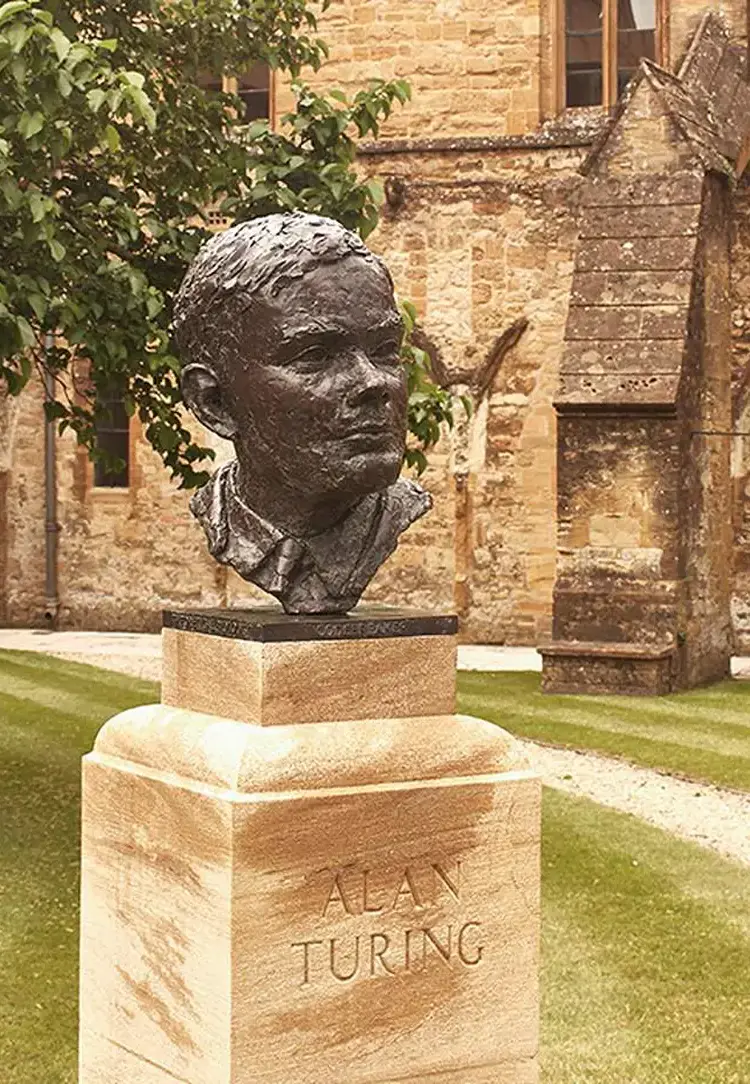
His subject suited him, and he suited it. He delighted most in teaching immunity and genetics and his timing was uncanny, for the Human Genome Project was launched in October 1990, almost the very week he first stood in front of a class. When he began, scientists had identified fewer than a hundred human disease genes; across the span of his career the entire human genome was read, mapped and laid open. There is a pleasing symmetry in this, for it was the Headmaster who, on that same interview day, first spoke to him of Alan Turing. The computing revolution Turing helped to father would, within David’s working life, go on to sequence the very blueprint of life itself. Whatever the technology, though, his approach never changed: make it accessible, make it honest, be fair and firm, with the occasional dose of tough love. He hoped pupils left his classroom with inspiration, a full set of notes, or at the very least a healthy sense of guilt.
The classroom gave him stories he will never shed: from the Third Former who called him “Dad”; to the Sixth Form who hid themselves and leapt out shouting “surprise". Beyond Biology, David has been a fixture of School life in countless guises – master in charge of squash, of tennis, of trains, of Wednesday afternoons; a singer in five school and town choirs; a tutor in School House from 1990 right through to 2026, serving under no fewer than five Housemasters. And then there is the camera. When he first ran the photography and darkroom club it was still a world of film and chemicals; Adobe released the very first version of Photoshop the same year he arrived, and over the decades that followed he rode the craft all the way from the darkroom to the digital age, becoming the School’s photographer and shaping the images for Vivat Shirburnia and Old Yet Ever Young, and the exhibitions that followed.
Thirty-six years is long enough to close a circle. A boy from David’s very first classes would now be in his fifties, quite possibly with a son who has himself since passed through the School, and David admits, with a smile, that the day has come when he watches boys make precisely the same mistakes their fathers once did. Yet ask him what he is proudest of, and he mentions neither the books nor the long service. He talks about the team, an “oasis,” he calls it, a happy place of real friendship, humour and mutual reliance that got him out of bed each morning and got the best out of the boys. That, more than anything, is what he leaves behind. We wish him a long and very happy retirement.
J-P Manning
Rory Shaw
Rory Shaw joined the Art Department in September 2025, at a moment when our Creative Digital Media numbers had grown faster than any of us had quite anticipated. We needed someone who could meet that demand and bring rather more to it than a textbook, and Rory was exactly that.
It would be remiss, however, not to declare his one glaring handicap at the outset: Rory is an Old Marlburian. Cut from much the same cloth as ourselves, admittedly, though one does not say so aloud, and certainly not in print. We resolved, in a spirit of great charity, to overlook it, and he has repaid that magnanimity many times over.
His background is in pre-production for film and commercials, and, crucially, he has not left it behind. On the days he is not with us, he is on real studio sets, doing the work for real. That gave him something rare in a classroom: not a memory of the industry but a current, working knowledge of it. When he spoke to the boys about how a shoot comes together, he had very possibly been doing it the previous afternoon.
He arrived, as he always seemed to, bright-eyed and bushy-tailed, though anyone who has worked a film set will recognise the faintly crazed gleam the job tends to leave behind.
The last twelve months have been a steep learning curve for Rory, met with unfailing good humour. He cut his teeth with some of our more reluctant digital media pupils, and anyone who has tried to coax sustained effort from a teenager who would rather be elsewhere knows this can feel less like teaching than pushing custard up a hill. What won them round was never a worksheet but the stories: insider accounts of what the film world is really like, the details no specification can supply. Suddenly, the work was not an exercise but a glimpse of a world they wanted to enter.
Rory leaves us at the end of this academic year, and we are genuinely sorry to see him go, Marlborough notwithstanding. He has been a generous, energetic and thoroughly likeable colleague, and we wish him every success in whatever comes next, with little doubt that, before long, we shall be spotting his name in the credits.
Matt Bone
Julia Slade
If you consider the energy Julia has devoted to her work at Sherborne Boys, it is hard to believe that she has been here for 22 years. A lover of variety, she has brought commitment and innovation to every aspect of school life. Her outstanding teaching in the MFL Department has never stood still. Always receptive to new ideas and pedagogy, she has ensured that pupils learn in an active, engaging and highly communicative environment. Whenever I have passed her classroom, I have paused to admire the hive of activity within: boys learning by doing, fully engaged and never bored.
Julia's contribution to learning has extended far beyond her own classroom. As an Initial Teacher Trainer, she has encouraged and supported younger and less experienced colleagues to develop their teaching skills. An impeccably thorough leader with a remarkable eye for detail, she has guided them with a calm but firm hand. As a Head of Department, I quickly came to appreciate these same qualities. I have never encountered a more efficient and organised colleague; she has quietly steered me through the complexities of school life and has always been on hand with the information, advice or reassurance needed at exactly the right moment.
In the Co-Curricular life of the School, Julia's energy and organisational skill have combined to great effect. She has built a wonderful, close-knit Polo community in which boys of all ages and abilities have been able to develop and thrive. She has also devoted weeks of her holiday time to supporting Gold and Silver Duke of Edinburgh's Award expeditions. Quite simply, she is the colleague to whom you would entrust any task, confident that no detail would be overlooked and that it would be carried through with characteristic calmness and independence.
Julia is an incredibly loyal colleague. She has served as a tutor in Harper House throughout her time at Sherborne, never wanting to leave the House she loved. The Housemaster's description of her contribution echoes the qualities that have characterised her work across the School: a calming presence, incredibly hardworking, always on the go, and an exceptionally kind and caring tutor. She has shown great skill in helping individual tutees navigate difficulties and challenges, supporting them with wise counsel and unfailing compassion.
Although the MFL Department is struggling to imagine life after Mrs Slade, not least because she bakes the most extraordinary cakes for our weekly meetings, we know that she has exciting plans beyond education. Whether pursuing her high-octane sporting interests or embarking on a new career in the charitable sector, she will bring the same energy, wisdom and quiet assurance that have characterised her time at Sherborne. All who have the privilege of working alongside her in the future will be fortunate indeed.
Judy Thurman
Mark Stuart
It has been said that you arrive at Sherborne as a boy and leave as a young man. Mark arrived as a fresh-faced 18-year-old gap student and leaves as a fresh-faced 25-year-old man. Compassionate and caring, Mark possesses huge warmth, and it is easy to see why so many boys warm to him. He is deeply committed and loyal to them.
Known to boys across the School for his leadership of the Duke of Edinburgh Award scheme, Mark has helped many boys across the finish line, whether by arranging volunteering opportunities, running expeditions, or helping with logbooks. Mark is a wonderful role model. He is not motivated by material possessions, as shown by the time he put the trip emergency fund of £500 in the bin.
Mark is a regular at Cross Fire, the School’s Christian Union, and remains a keen swimmer, having represented South Africa as a schoolboy. He has supported Water Polo and has livened up many a CCF session with the laser tag weapons. Mark is a traveller and intrepid by nature, so it may surprise some that he is also so fastidious about looking after his hair - yes, Mark, we’ve noticed.
A man of many talents and interests, including piano, karaoke, and Harry Styles, he is picked on remorselessly by The Digby House team to keep him grounded. By the time many staff have donned their glasses and tried to get the interweb up on their phones, Mark has already updated his legion of social media followers on all things CCF, DofE, and The Digby. He has been a one-man marketing machine.
Many of us have benefited from Mark’s warm and easy company, but it is as a Resident Tutor that he has really come into his own. A wonderful listener, he has given innumerable boys countless hours of gold-standard pastoral care. Mark is greatly appreciated by the boys, their families, and the whole Sherborne community. We cannot wait to hear about his next chapter and wish him every success and happiness in the world.
Rob Le Poidevin
Min Walker
To come
James Hull
Paul Walter
Paul joined us from Our Lady’s, Abingdon and quickly made his mark as Head of Department with his strong views on the place of mathematics in the secondary curriculum. His skills and experience with computers have helped the department enormously over the past couple of years and his work with the brightest of our boys has been very effective. As a tutor in Wallace House, both resident and non-resident, he was a highly conscientious and reliable member of the pastoral team.
He leaves us to take up a position at Tonbridge School, a school with an outstanding mathematical reputation, where I am sure he will thrive. We wish him very success and happiness.
Tim Dawson
Emma Wimhurst
When Emma Wimhurst arrived in February 2024, did she bring an immediate sense of calm? Not a chance. No one would ever describe Emma as "calm." But more on that later, because what she did bring was exactly what was needed.
Her reputation for outstanding teaching at Sherborne Girls preceded her, but it turned out she was even better suited to teaching boys, hitting the ground running without a single jitter. Her background in business gives her credibility, confidence, and an innate ability to bring business concepts to life through real-world examples. But it is her personal qualities - energy, perfectionism, organisation, passion, and above all a deep care for her pupils' progress, that marks her out as a truly outstanding teacher.
As a tutor, Emma has been exceptional. Overhearing snippets of her conversations with tutees and their parents has, frankly, made me feel rather inadequate by comparison. She has been an example to us all.
If there's one word I associate with Emma above all others, it's "love." No nonsense – straight forward “love”, no nuanced subtlety. That would not be appropriate for Emma. Many is the time I have overheard such statements as “Ms Wimhurst pupils all love her”, while Emma herself often used the word when discussing her feelings for the classroom and even supervising third formers in house – “I love it”. What did the pupils love about her? Beyond all the skills and qualities already mentioned, it was her no-nonsense approach. She held pupils to account in no uncertain terms — raised voice and all — but they understood why, and loved her for it. Ultimately, they knew she was on their side.
As a colleague, Emma has been great company - ever helpful, and always entertaining in departmental meetings, firing "broadsides" into policies she felt wouldn't work. She has always been generous with her time too; even in her final weeks at the school, she gave up a day to help me run a sailing regatta. And then there's her sense of style. The Economics and Business department has never, in my time, been known for its fashion sense and pride in personal appearance, but for the last two and a half years, we've had one beacon of light in that regard. One of the very few times I ever heard her say that she could not step into the breach and give up her time was when she said she had a hair appointment she could not miss. The full-length mirror she insisted on having installed in our office will outlast her, and when we look into it, we'll probably, I hope, think of Emma rather than focus on our sartorially disastrous reflection.
Emma will be missed greatly, and Poole Grammar — and its pupils — are the lucky ones.
Michael Ewart-Smith
James Winter
Sherborne was lucky to have James Winter for a decade and a half. Certainly the boys knew it. The best common rooms have someone for everyone – a wide gamut of teachers so that niche interests are covered when the pupils explore them – and James was several of those teachers all at once. Boys who just had to pursue studies in the philosophy of language, or literary theory, or logic, knew where to find him. Several ended up at Oxbridge. One of them found that his Cambridge dons had little to tell him about Milton after a course on Paradise Lost with James. Come to think of it, when James did an MA at Cambridge on Milton’s philosophy, they had a problem finding someone to supervise him.
All of which suggests a genius meting out wisdom to a lucky few, and that’s misleading for a number of reasons. One is that his love of learning is infectious. Another is that he was there for everyone. It’s not just that he brought home how much the study of literature enriches all its students. He was also a particularly powerful and empathetic tutor, often taking the role of advocate for those who were misunderstood, or who faced conflicting expectations. In such cases, it would be James who argued for a clear path, in sometimes bracingly clear language.
A third reason is just how generous he is with his nous and skills. His critical thinking sessions were widely loved; he drew people to debating who quickly learned to pull a premise from under their opponents’ feet; and he put on properly challenging plays, such as Brian Friel’s Translations, Marlowe’s Doctor Faustus and Vaclav Havel’s Largo Desolato, about the difficulty of maintaining one’s intellectual integrity and principles.
Obituaries in the Telegraph have a special phrase for VCs, saying that they showed “a reckless disregard for [their] own safety”, which feels true of James, whom the Dean of Staff once sent to have a haircut. I’m not sure that James did this; and when he was told to discourage a boy from reading a poet called Bryon, I’m not sure that he did that either, perhaps relying on a loophole: read Byron all you like, but stay away from Bryon. But the School was stronger for his exploration of boundaries: our subject allows us to introduce pupils to new and exciting work, through coursework, which is how come some of the finest minds of Sherborne’s recent generations have tackled the work of Sarah Kane, and analysed Frank O’Hara’s poem “Lana Turner Has Collapsed”.
Those of us who have worked closely with James will miss collaborating with someone so smart, and funny with it, as well as kind and supportive. I’ll always remember how lucky I was to share sets with him, so that we could dovetail conversations about Hamlet, Tom Stoppard and immigration literature. And we’re both grateful to this publication, for allowing us space to illustrate how English Language A Level works with our email exchange about oatmilk cartons.
Tom Payne
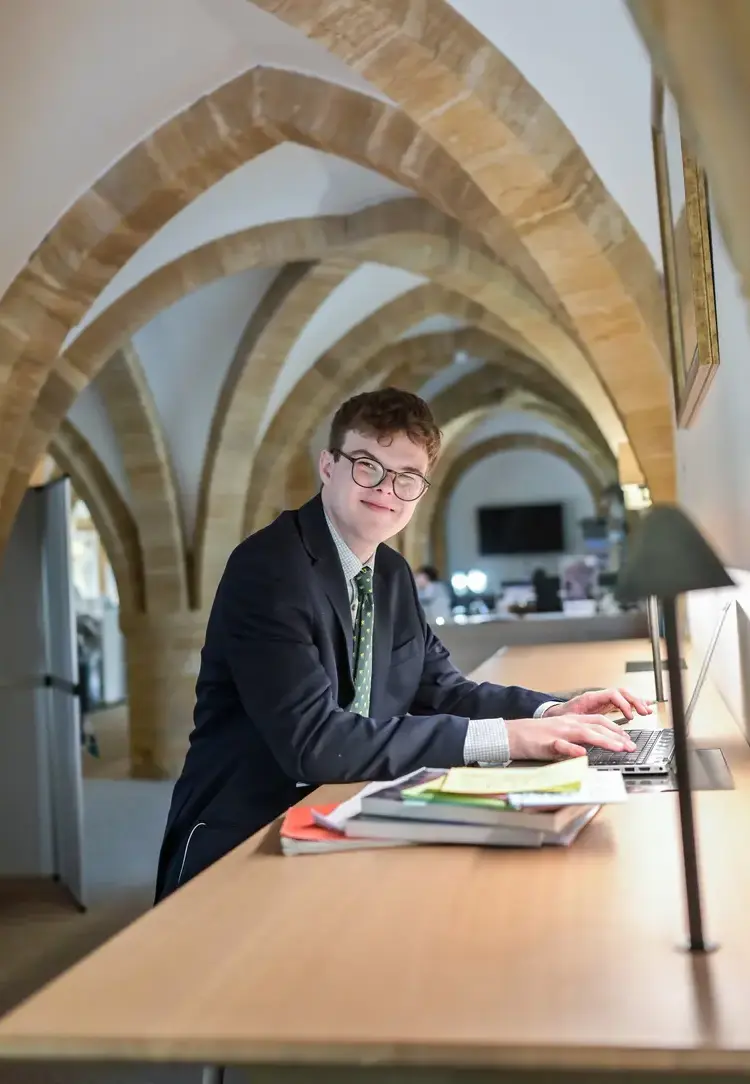
Expert Careers & Higher Education Guidance
Throughout the Sixth Form, pupils benefit from expert careers and higher education guidance, helping them navigate choices and set ambitious goals.
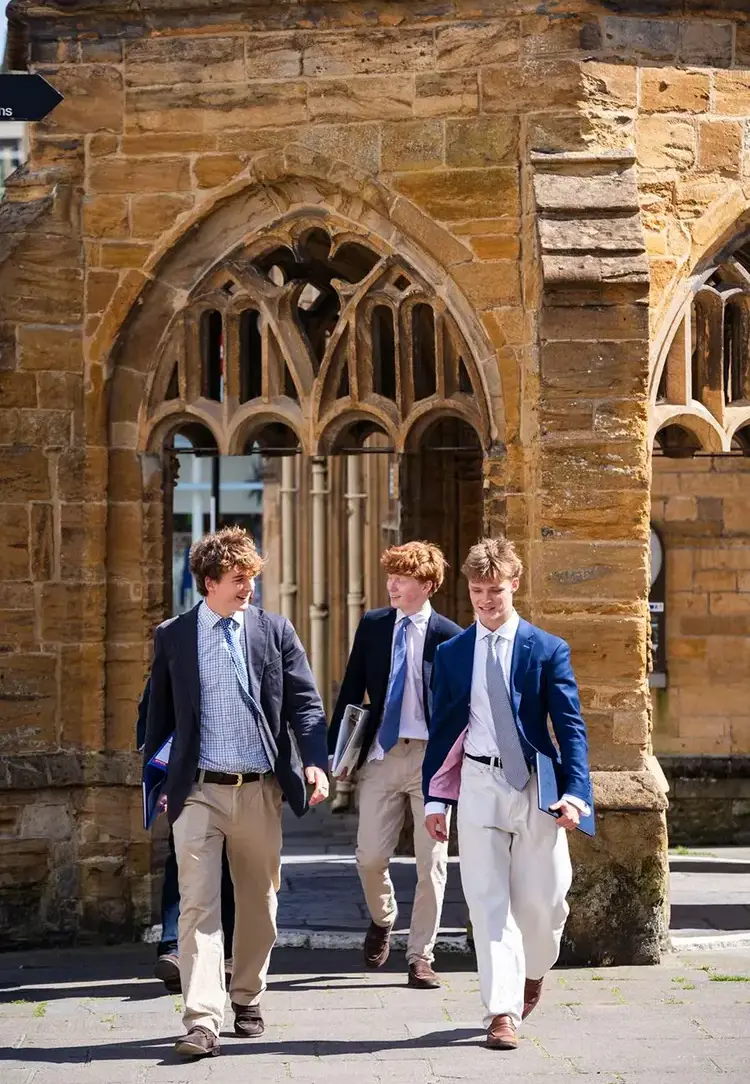
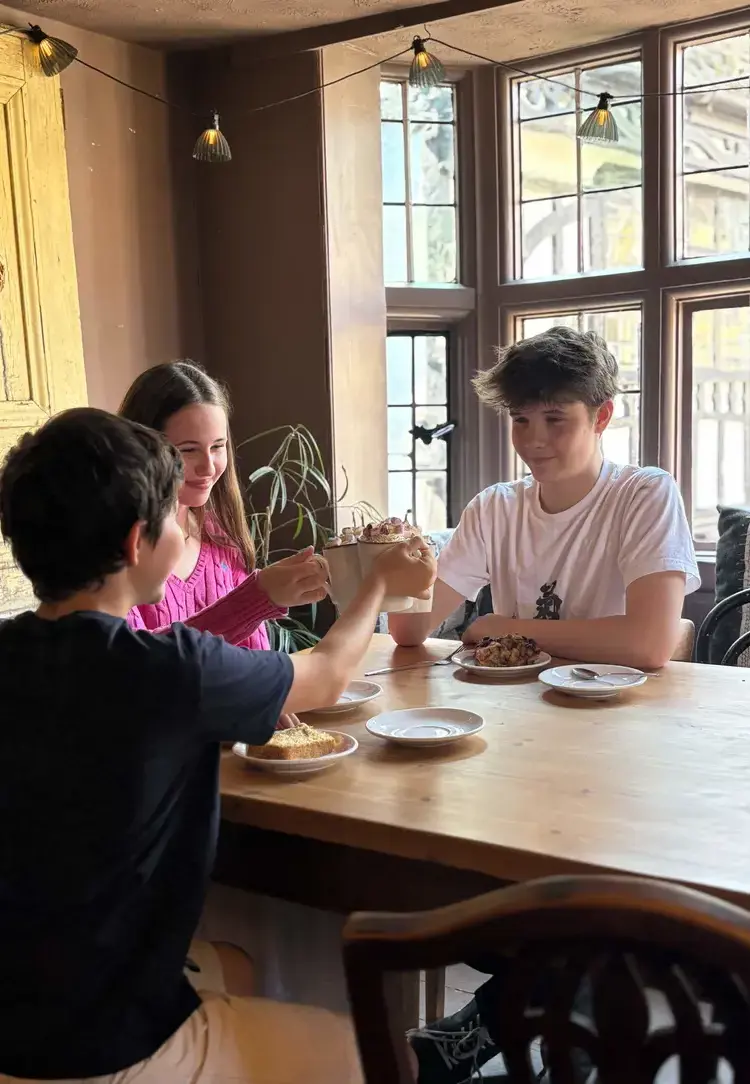
The result is a vibrant, distinctive community where boys grow in independence, confidence, and ambition. Our close working relationship with Sherborne Girls also offers Sixth Formers opportunities to mix across debating, career conventions, CCF, trips, socials, and the highly anticipated Leavers' Ball – to name just a few!
Click here to discover more about what makes Sherborne's Sixth Form offering so unique and to hear from Lower Sixth Oliver and Upper Sixth Veljko.